3 hr
Osaka Shinsekai Food Tour: 15 Dishes & 3 Drinks
Taste your way through hidden Osaka eateries with a local guide—15 authentic dishes in 3 hours.
Reserve
Hand-picked by our editors — only the best 5 private culinary experiences from 127 reviewed.
Verified partners for every tour, free cancellation where available, and instant confirmation on every booking.
3 hr
Taste your way through hidden Osaka eateries with a local guide—15 authentic dishes in 3 hours.
Reserve
3 hr
Award-winning culinary walk through retro Osaka—kushikatsu, takoyaki, yakitori and more in a historic quarter
Reserve
3 hr
Dive into Osaka's retro neon district with a guided tasting journey through four neighborhood spots.
ReservePrices from verified partners. Availability updates in real time at checkout. Free cancellation policies apply where shown.
The landmarks, rooms, and views travelers on this tour remember — all visible on a single visit.
The heart of the city, this waterway is lined with mechanical signs and countless food stalls. The area sees thousands of visitors during the evening peak.
A preserved historic alley that survived WWII, containing the mossy Fudo Myoo statue. This small street measures approximately 80 meters in length.
Known as the kitchen of the city, this market features over 150 shops selling fresh seafood and seasonal produce. It is a vital stop for any food enthusiast.
This district serves as the epicenter of youth fashion, with its own iconic landmark, the Triangle Park. It has been a cultural hub since the 1970s.
This unique shrine is famous for its massive lion head stage that stands 12 meters high. It attracts visitors seeking prosperity and success.
They complement each other; most visitors who do both call the guided experience the more insightful option for deep cultural immersion. Choosing an osaka food tour private booking allows travelers to bypass language barriers and gain instant access to local knowledge.
| Feature | Top pick Private Food Tour | Self-Guided Exploration |
|---|---|---|
Local Expertise |
Professional local guide | Personal research required |
Navigation Ease |
Seamless lead follow | Requires digital maps |
Language Support |
Full translation services | Limited to native signage |
Hidden Gem Access |
Exclusive vendor introductions | Public access only |
Cultural Context |
Deep historical narrative | Surface level observation |
Social Interaction |
High with local vendors | Minimal to none |
| See tickets → |
Verdict: Opt for osaka food tour private tours if you prioritize curated, historical context, whereas self-guided osaka food tour private tickets are better suited for those who prefer complete control over their itinerary and pace.
Choose your ticket, select your date, and reserve in under two minutes. Secure checkout handled by our verified partner.
Instant confirmation by email, with a mobile voucher you can save offline. No printing, no queuing at a collection desk.
Arrive at the entrance, show your voucher on your phone, and walk in. Most tickets include priority or skip-the-line access.
Practical details for your visit straight from our verified partners — hours, access, rules, and how to get there.
Osaka, Japan
Look for your guide holding a sign
Use the Midosuji subway line to reach central stations.
Available throughout the city but traffic can be slow during peak evening hours.
Casual and comfortable clothing is recommended for an osaka food tour private. Wear supportive footwear for walking through crowded market lanes.
Keep belongings minimal as storage is not available during your osaka food tour private. Security protocols depend on individual establishment policies.
Photography is generally permitted in public areas, but always request permission before taking photos inside private shops during an osaka food tour private.
Navigating narrow market streets can be challenging for those with mobility aids. Discuss specific requirements with your guide before your osaka food tour private.
Mobile phones are permitted for capturing memories of your experience. Please keep volumes low to respect other diners.
Families are welcome, though some venues may have limited space for strollers. An osaka food tour private can be tailored to accommodate younger palates.
The tour includes multiple tastings at various local eateries. Please inform your guide of any dietary restrictions prior to starting your osaka food tour private.
Pets are not permitted on these guided walking excursions. Service animals must be cleared with the operator in advance.
Each osaka food tour private provides a unique look at local culinary traditions. Guides are happy to share insights into the city's complex history.
Best time to go, insider tips, nearby landmarks, and the cancellation fine print — flip through to skim what matters to you.
How crowds, weather, and events shift across the year.
High temperatures and humidity define this period, ideal for evening food exploration when streets are lively.
Mild temperatures make walking very pleasant, with many seasonal ingredients appearing in market stalls.
Crisp weather is perfect for hot comfort foods, though outdoor streets are less crowded.
Cherry blossoms draw large crowds, creating a festive atmosphere throughout the city.
Small details that turn a good visit into a great one.
Secure your date well in advance to ensure guide availability for your osaka food tour private.
Non-bookable sights within a short walk — free to visit, easy to pair.
Famous canal area known for neon signs and street food.
A quiet, historic alleyway with a moss-covered statue.
The center of youth culture and unique fashion in Osaka.
A green oasis integrated into a large shopping complex.
Flexible, no hidden fees.
Full refunds are provided for cancellations made within the operator's specified window. Note that the entrance fee for public districts is 0 JPY.
Hand-picked options within walking distance — pick a district for vibe, or a specific hotel for convenience.
Central area with many hotels near major transit hubs.
Stylish area known for shopping and high-end dining.
Northern hub with premium skyscraper accommodations.
Osaka earned its nickname *kuidaore no machi*—the city where you eat until you drop—not through marketing, but through four centuries of merchant-class appetite. By the Edo period, the port's rice brokers and textile traders had built a culinary culture so prolific that Tokyo's samurai elite dismissed Osaka as a place concerned only with profit and pleasure. That dismissal became the city's pride. Today, Osaka sustains more independent restaurants per square kilometer than any other Japanese metropolis, and its signature dishes—takoyaki, okonomiyaki, kushikatsu—remain defiantly working-class, sold from street stalls and century-old shops where recipes pass through families, not corporations. A private culinary tour through Osaka's historic districts offers access to venues that do not advertise and chefs who do not speak English. Shinsekai, built in 1912 as an amusement district modeled on Paris and Coney Island, retains its prewar grid of narrow lanes where kushikatsu—skewered, breaded, and fried in 200-degree rapeseed oil—is served under house rules posted in hand-painted characters. Ura Namba, the backstreet network behind Namba Station, shelters izakayas whose entrance curtains have hung for sixty years, and whose proprietors recognize regulars by voice. Dotonbori, anchored by the Glico Man sign installed in 1935, remains the city's commercial soul, its canal-side arcades lit by neon scripts that have survived war, recession, and redevelopment. Osaka food tour private experiences are structured around tasting progressions—twelve to seventeen courses depending on route—that trace the city's layered food economy. Guides, many of whom trained in hospitality before shifting to cultural interpretation, navigate language, etiquette, and timing: explaining the dashi stock tradition that underpins okonomiyaki batter, securing counter seats at hidden yakitori grills, timing arrival at dorayaki shops when the anko filling is still warm. These walks are not restaurant samplers. They are guided interviews with a city that built its identity on eating well, eating often, and eating without pretense. The evening window—between 5 PM and 8 PM—remains optimal. Stalls open, grills are lit, and the districts shift from transit corridors to dining theaters. Reservations are handled by verified operators who coordinate group size, dietary restrictions, and district access in advance, ensuring that private culinary tours in Osaka move through the city at the rhythm its food culture demands: unhurried, specific, and always hungry.

"Osaka earned its nickname kuidaore no machi—the city where you eat until you drop—not through marketing, but through four centuries of merchant-class appetite."
A step-by-step walkthrough of the visit — what you'll see, how long each stage takes, and the details that matter.
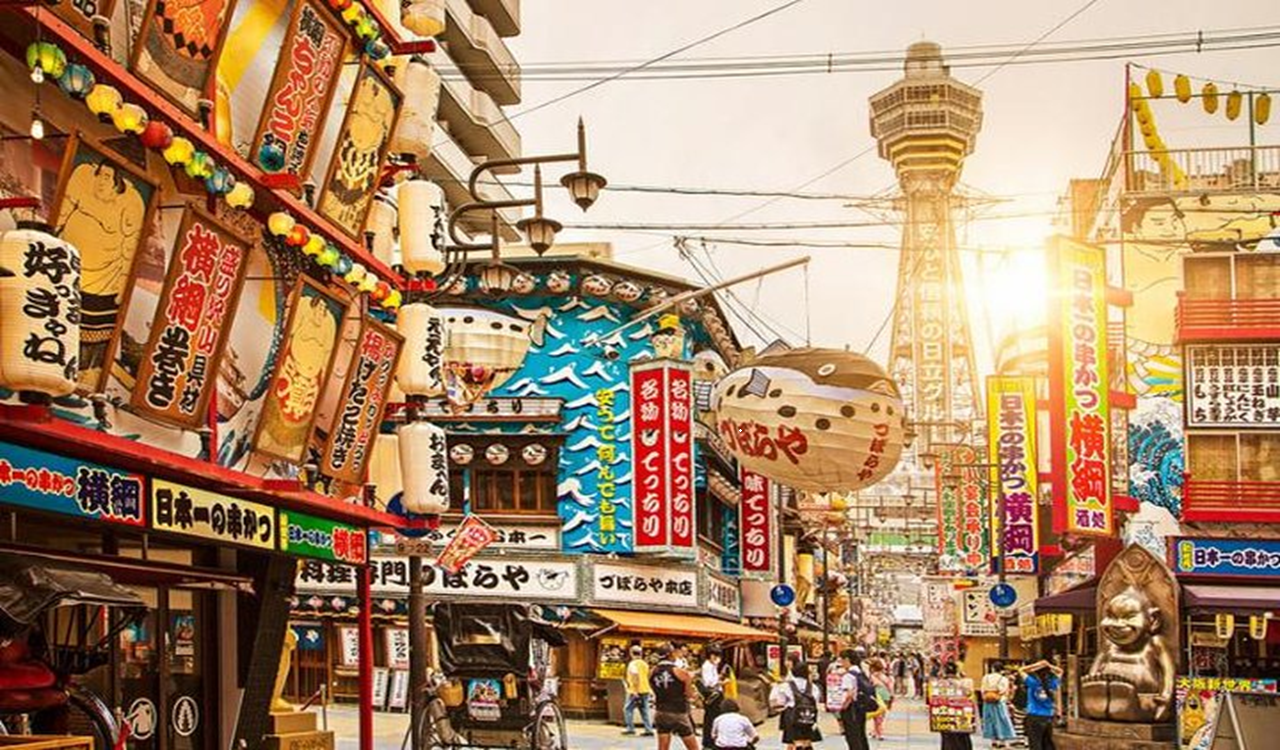
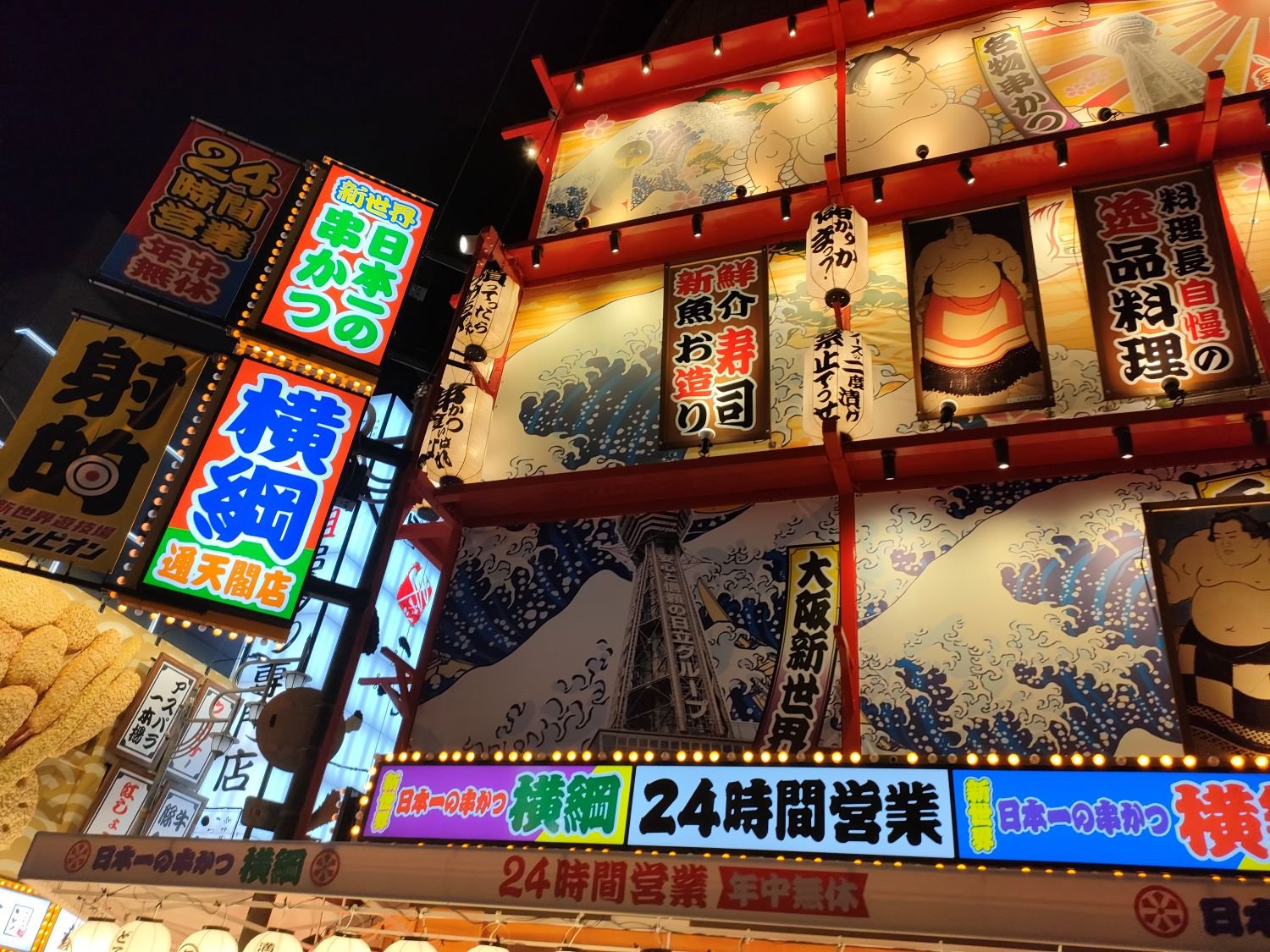
You meet your guide near Tsutenkaku Tower as the evening shift begins, the Shinsekai district glowing under paper lanterns and decades-old signage. The first stop is a kushikatsu counter where twelve skewers—lotus root, quail egg, pork belly—emerge golden from oil kept at a constant temperature since 1952. You dip once, never twice; the communal sauce pot is house law. Two blocks east, you step into an okonomiyaki shop where batter hits the griddle with a hiss, and you watch cabbage, beni shoga, and bonito flakes fold into a pancake the size of a dinner plate. The chef slides it onto your spatula, still bubbling. Ura Namba's backstreets narrow as you walk. Your guide pulls aside a noren curtain, and you're inside an eight-seat izakaya where the menu is written in chalk and the chef knows your guide by name. Yakitori arrives on small plates—three skewers of negima, glazed and smoky. A small pour of local sake follows. You cross the Dotonbori canal as the Glico Man blinks overhead, then stop at a takoyaki stall where octopus chunks are flipped in hemispherical molds, topped with sauce and aonori, and handed to you in a paper boat, each ball molten at the center. The walk ends at a dorayaki shop where the anko paste is made that morning. You leave carrying the city's rhythm: small plates, constant motion, and the knowledge that Osaka is best understood through what it serves.
An osaka food tour private can be scheduled anytime, with the optimal arrival window being 17:00–20:00.
Accessibility for an osaka food tour private varies by venue, so consult your guide regarding mobility needs.
The best time to experience the vibrant evening atmosphere for an osaka food tour private is 17:00–20:00.
No, the entrance fee is 0 JPY as these tours take place on public streets.
Outside food is generally not permitted during your osaka food tour private as the tour includes curated tastings.
Tickets for an osaka food tour private can be secured through our official booking platform.
Children are welcome to join an osaka food tour private, provided they are included in the group reservation.
Cancellations for an osaka food tour private must be made within the designated window for a full refund.
Photography is usually fine on an osaka food tour private, but always ask before shooting inside small shops.
You can easily combine your osaka food tour private with visits to Dotonbori or Hozenji Yokocho.